
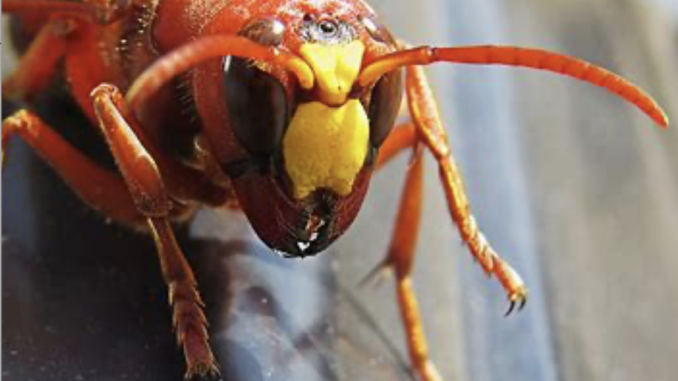
Alan Wade
Vespa orientalis
Source: Fity Club
Moreover the Lord thy God will send the hornet among them, until they that are left, and hide themselves from thee, be destroyed. Thou shalt not be affrighted at them: for the Lord thy God is among you, a mighty God and terrible.
And as further dire warning:
Neither shalt thou bring an abomination into thine house, lest thou be a cursed thing like it: but thou shalt utterly detest it, and thou shalt utterly abhor it; for it is a cursed thing.
Deuteronomy 7
Occasionally, when searching for the good oil on a topic that defies a simple Dr Google search, one happens upon a blog that answers most of the questions one might ask. We all know of the principle predators of honey bees – apart from the giant raiders: bears, mice, grey skunks, elephants, cane toads, humans and an assortment of birds – already familiar to us: the greater and lesser wax moths, the small hive beetle, two large African hive beetles and assorted wasps and hornets. We know of these because of their reputation for destroying whole hives of bees in the wink of an eye.
Of all these sudden death predators, however, perhaps the most feared are the Asian hornets. We hear of harrowing news reports of the yellow-legged hornet (Vespa velutina) making an easy meal of honey bees and its spread from Asia through China to Russia and beyond to threaten European beekeeping (López et al., 2011; Monceau et al., 2014).
But as that blogger of all things insect and arachnid Emily (2025) points out there are seven well recognised Asian hornets. Check out her images if you want a quick overview of the menace these hornets present. In a broader sweep of the evolutionary battle between hornets and bees Cappa et al. (2021) argue that:
…hornets and honey bees seem to have reached a fragile balance, which is lost when alien hornet species are accidentally introduced into new geographic areas.
Amongst the aculeate stinging wasps and bees, the ten families of vespoid or vespoid-like wasps stand out as the stingers to avoid when rambling in the meadow. Most are solitary insects but their sting is something else. On the other hand the social wasps and hornets (Figure 1) are an existential threat not only to honey bees but also to human wellbeing.
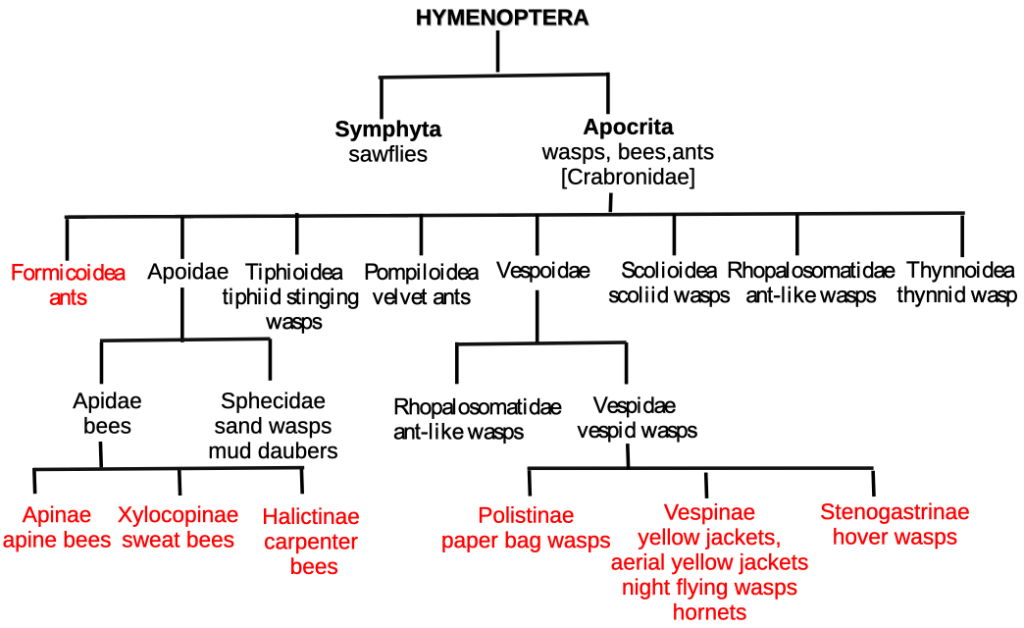
Figure 1 Crabronid hymenopteran wasps showing where the vespoid stinging wasps including hornets fit in. Social subfamilies are highlighted in red.
Note that recent genetic studies (Wikipedia, 2024) have signalled reclassification of many genera in the vespoid (Vespoidae) superfamily into separate paraphyletic groups, elevating many genera to new superfamilies: Vespoidae (Vespidae) – vespid wasps – and Rhopalosomatidae – ant-like wasps, Formicoidea – ants, Scolioidea – scoliid wasps, Tiphioidea – tiphiid stinging wasps, Thynnoidea – thynnid wasp parasitoids of beetle larvae and sun spiders – and Pompiloidea – velvet ants, mrymosid wasps – spider wasps and sapygid wasps.
The large family Vespidae contains many solitary as well as nearly all the eusocial wasps: the Vespinae (yellowjackets and hornets), the Polistinae (paper wasps) and the Stenogastrinae (hover wasps) showing key eusocial genera (Figure 2). Amongst these aculeates, the hornets appear as stand alone and fearsome predators of invertebrates, notably of honey bees.
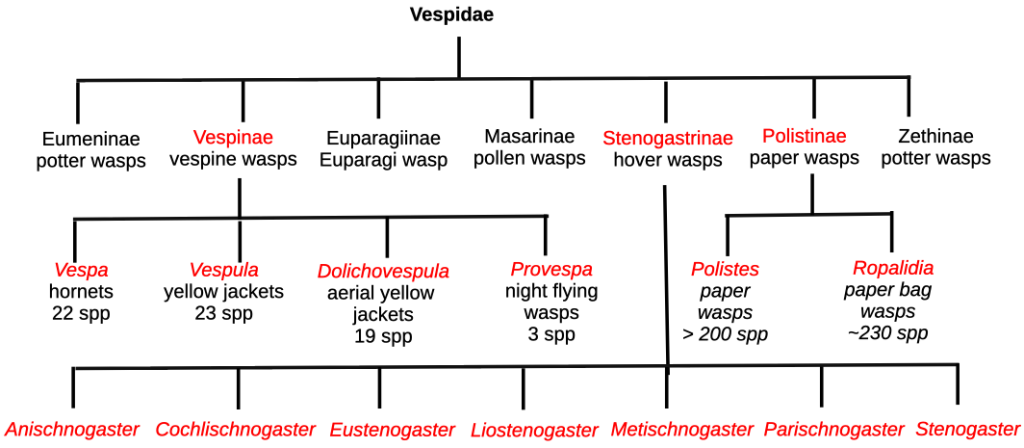
Figure 2 Expanded clade of vespid wasps showing key genera of eusocial vespine, hover and paper wasps. Other genera of hover wasps (Polistinae) are not shown.
Carpenter and coworkers (2013) and Smith-Pardo et al. (2020) have mapped out the relatedness of the existing twenty two hornet species mainly basing their classification on the extensive studies of Michael Archer (1991a, 1991b, 1992, 1993a, 1993b, 1994a, 1994b, 1995, 1997, 1998a, 1998b, 1999, 2008) (Figure 3). Excluding less related outliers, Vespa basalis and Vespa binghami, and the solitary and widespread temperate species, Vespa orientalis, they categorised theminto four groups based on their morphology – one a sub-group of the Vespa affinis clade. Vespa crabo, Vespa dybowskiiand Vespa orientalis are of temperate (non Asian) origin.
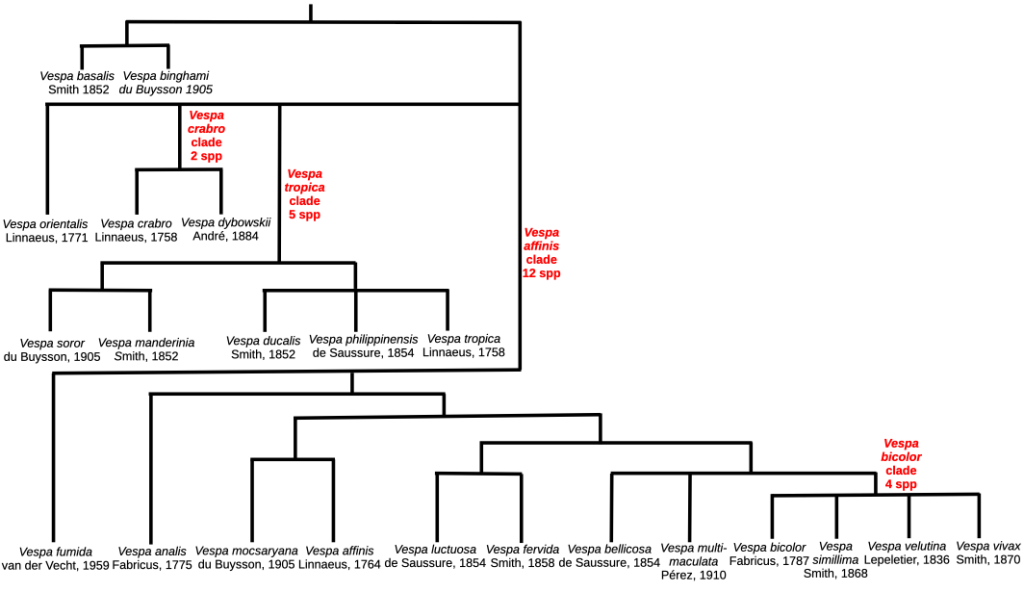
Figure 3 Relatedness of hornet species based on a mix of morphological and genetic data.
Redrawn after Carpenter et al. (2013).
Many subspecies and colour forms are recorded in the literature and this has proved so confusing that only species names are now accepted while local colour morphs are informally recognised. The more temperate northern population of the Yellow-legged hornet is the form that has spread through Russia, China and more recently to eastern Europe devastating honey bees, but would appear to be only an exemplar of the hornet-spreading phenomenon.
Other invasive hornets
The much publicised detections of the Northern giant hornet in North America in 2019 and 2021 and the march of the Yellow-legged hornet across Western Europe (Figure 4) has raised awareness that hornets in general present an enormous threat to honey bees and indeed to global insect fauna. Ottis et al. (2023a, 2023b) outline establishment of at least seven highly destructive hornet species outside their natural range (Table 1). In an introductory note they report Robin Edwards (1982) recording hornets as gifts:
Jacob Ishay, it seems, has started sending me Christmas presents from Israel. I assume it must be Ishay, for who else would have beautiful live queens of Vespa orientalis to give away? The strange thing is that he has packed them in crates of grapefruits and oranges and sent them via two British supermarkets.
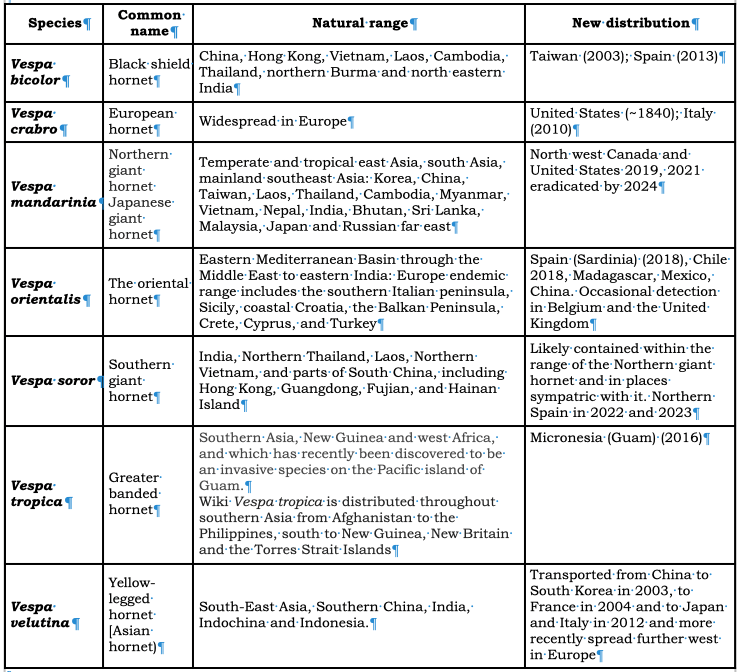
Table 1 Hornet range expansion (Otis et al., 2003). Predator status varies and many, but not all, target honey bees. For example the Oriental hornet has a diet of fruit and plant sap but predates on polestine and stenogastrine wasps as well as honey bees to supply larval protein requirements. Other species either hawk bees limiting colony development while the northern and southern giant hornets, the Yellow-legged hornet and the Greater banded hornet invade and destroy honey bee colonies.
In a signature study Cappa and coworkers (2021) signal the susceptibility of different honey bee species to hornet species around the globe (Table 2) and where introduced Apis mellifera are most susceptible.
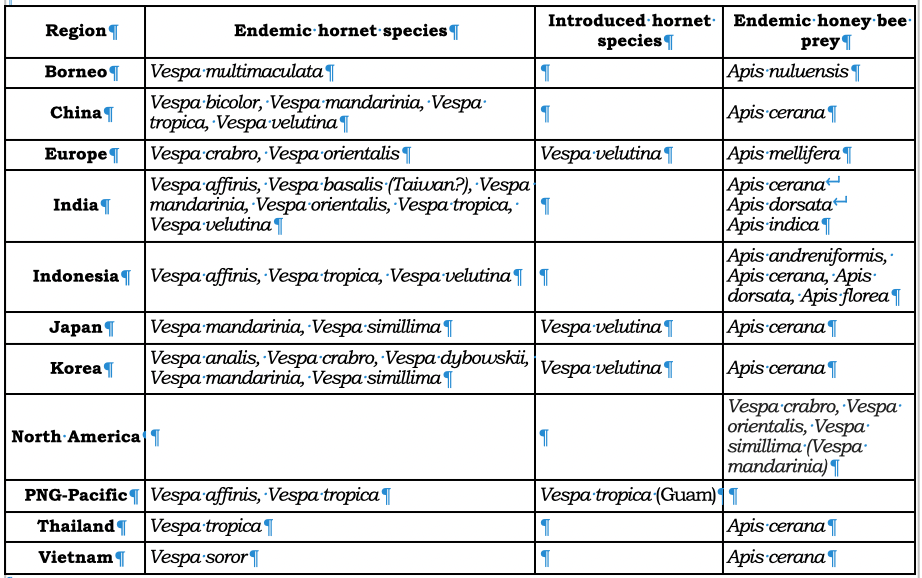
Table 2 Regional hornet association with honey bees. Apis mellifera, introduced across all except Europe, Africa and the Middle East, are primary hornet prey and have weakly developed defence strategies.
Source: Cappa et al. (2021) extended to include Indonesia and the PNG-Pacific.
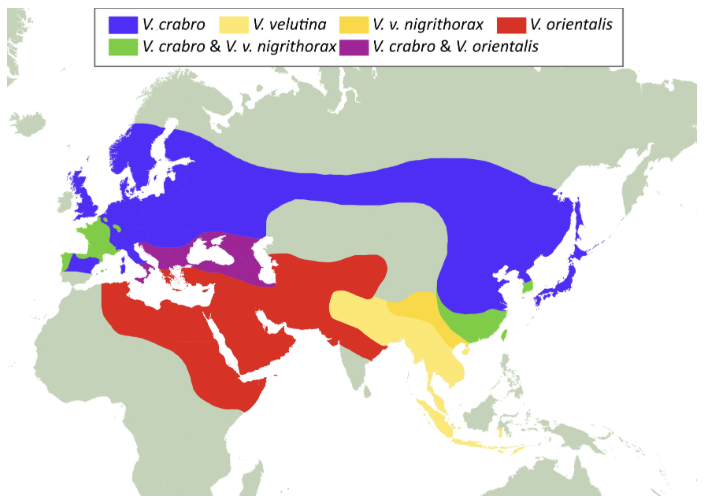
Figure 4 Natural ranges of the European and Oriental hornet and the expanding range of the Yellow-legged hornet (green and darker yellow).Source: European Climate, Infrastructure and Environment Executive Agency. (downloaded 10 August 2025).
Note: The European Hornet, Vespula crabro, is now widely established in North America as subspecies Vespa crabro nigrithororax (darker yellow) is now established in China, Russia and finding its way to eastern Europe.
A wider cohort of threatening hornets
The biologies of the temperate zone hornets, Vespa crabo and Vespa orientalis (Glaiim, 2009) are well studied. These hornets hawk honey bees, and have done immeasurable damage to native insect fauna outside their natural range, Vespa orientalis famed for finding a niche in arid zones, while a new study by Zucca et al. (2024) suggests that it may also be a vector, as is often assumed for wasps in general, of bee viruses and other honey bee pathogens. The oriental hornet spread to Spain in 2012 (Hernández et al., 2013), to Romania in 2019 (Zachi and Ruicanescu, 2021), to France in 2021 (Brunet et al., 2022; Gereys et al., 2021) and there are new introductions to the Greek islands (Ceccolini, 2022).
The tropical and subtropical hornets are another kettle of fish. As apex predators, the Northern giant hornet Vespa mandarinia (Powell, 1920), the Southern giant hornet Vespa soror (Mattila et al., 2023; Sánchez et al., 2024) and the semi-temperate northern race of the Yellow-legged hornet Vespa velutina (Monceau et al., 2014; Powell, 1920) are famed for their systematically attacking and destroying honey bee colonies.
Having identified the full spectrum of hornets and their natural distribution and having discovered which species have already become endemic elsewhere, we can hazard a guess as to which other species are likely to become problematic. Many species are proximate to the Pacific, New Zealand and Australia a region essentially free of hornets: Vespa tropica,however, is now well-established in Guam.
The Lesser banded hornet (Vespa affinis), the Yellow-vented hornet (Vespa analis), the Black-bellied hornet (Vespa basalis), the Black shield hornet (Vespa bicolor), the Black hornet (Vespa ducalis), the Yellow hornet (Vespa simillima) and the Southern giant hornet (Vespa soror) are aggressive so must be considered a biosecurity risk. Other known species, Vespa binghami, Vespa dybowskii, Vespa fumida, Vespa mocsaryana, the Many-banded hornet Vespa multimaculata, Vespa philippinensis and Vespa vivax are rare or isolated hornet species so would appear unlikely to present significant risk to honey bees globally.
What will be will be. However it is hard not to recognise that, as some stage, hornets will break through:
After which, Laws are like Cobwebs, which may catch small Flies, but let Wasps and Hornets break through. But in Oratory, the greatest Art is to hide Art.
A critical essay upon the faculties of the mind
Jonathan Swift 1707.
Readings
Archer, M.E. (1991a). The number of species that can be recognised within the genus Vespa (Hym., Vespinae). Entomologist’s Monthly Magazine 127(1524-1527):161-164. https://www.academia.edu/4236687/The_nmber_of_species_that_can_be_recognised_within_the_genus_Vespa_Hym_Vespinae_1991_
Archer, M.E. (1991b). Taxonomy and bionomics of the Vespa tropica group (Hym., Vespinae). Entomologist’s Monthly Magazine 127(1528-1531):225-232. https://www.academia.edu/4236712/Taxonomy_and_Bionomics_of_the_Vespa_tropica_group_Hym_Vespinae_1991
Archer, M.E. (1992). The taxonomy of Vespa crabro L. and V. dybowskii André (Hym., Vespinae). Entomologist’s Monthly Magazine 128(1536-1539):157-163.https://www.academia.edu/4236725/The_taxonomy_of_Vespa_crabro_L_and_V_dybowskii_Andre_Hym_Vespniae_1992_
Archer, M.E. (1993a). The life history and characteristics of the hornet, Vespa crabro L. (Hym., Vespinae). Entomologist’s Monthly Magazine 129(1548-1551):151-162. https://www.academia.edu/4275884/The_life_history_and_colonial_characteristics_of_the_hornet_Vespa_crabro_L_Hym_Vespinae_1993
Archer, M.E. (1993b). A phylogenetic study of the species of the genus Vespa (Hymenoptera: Vespinae). Entomologica Scandinavica (Grp 4) 24:469-478. Copenhagen, Denmark.https://www.academia.edu/3685645/A_phylogenetic_study_of_the_species_of_the_genus_Vespa_Hymenoptera_Vespinae_1994
Archer, M.E. (1994a). A phylogenetic study of the species of the genus Vespa (Hymenoptera: Vespinae). Insect Systematics and Evolution 24(4):469-478.
Archer, M.E. (1994b). Taxonomy, distribution and nesting biology of the Vespa bicolor group (Hym., Vespinae). Entomologist’s Monthly Magazine 130(1560-1563):149-158. https://www.academia.edu/4236740/Taxonomy_distribution_and_nesting_biology_of_the_Vespa_bicolor_group_Hym_Vespinae_1994_
Archer, M.E. (1995). Taxonomy, distribution and nesting biology of the Vespa mandarinia group (Hym., Vespinae). Entomologist’s Monthly Magazine 131(1568-1571):47-53. https://www.academia.edu/4236755/Taxonomy_distribution_and_nesting_biology_of_the_Vespa_mandarinia_group_Hym_Vespinae_1995_
Archer, M.E. (1997). Taxonomy, distribution and nesting biology of Vespa affinis (L.) and Vespa mocsaryana du Buysson (Hym., Vespinae). Entomologist’s Monthly Magazine 133(1592-1595):27-38. https://www.academia.edu/4236774/Taxonomy_distribution_and_nesting_biology_of_Vespa_affinis_L_and_Vespa_mocsaryana_du_Buysson_Hym_Vesoinae_1997_
Archer, M.E. (1998a). Taxonomy, distribution and nesting biology of Vespa analis F. (Hym., Vespidae). Entomologist’s Monthly Magazine 134(1610-1601):215-222. https://www.academia.edu/4236786/Taxonomy_distribution_and_nesting_biology_of_Vespa_analis_F_Hym_Vespidae_1998_
Archer, M.E. (1998b). Taxonomy, distribution and nesting biology of Vespa orientalis L. (Hym., Vespidae). Entomologist’s Monthly Magazine 134(1604-1607):45-51. https://www.academia.edu/4236674/Taxonomy_distribution_and_nesting_biology_of_Vespa_orientalis_L_Hym_Vespidae_1998_
Archer, M.E. (1999). Taxonomy, distribution and nesting biology of Vespa binghami, V. basalis, V. variabilis, V. fervida, V. luctuosa, V. multimaculata and V. bellicosa (Hym., Vespinae). Entomologist’s Monthly Magazine 135(1616-1619):43-50. https://www.academia.edu/4236802/Taxonomy_distribution_and_nesting_biology_of_Vespa_binghami_V_basalis_V_variabilis_V_fervida_V_luctuosa_V_multimaculata_and_V_bellicosa
Archer, M.E. (2008). Taxonomy, distribution and nesting biology of species of the genera Provespa Ashmead and Vespa Linnaeus (Hymenoptera, Vespidae). Entomologist’s Monthly Magazine 144(1727):69-101.https://scholar.google.com/scholar?hl=en&as_sdt=0%2C5&q=Taxonomy%2C+distribution+and+nesting+biology+of+species+of+the+genera+Provespa+Ashmead+and+Vespa+Linnaeus+%28Hymenoptera%2C+Vespidae%29&btnG=
Brunet, J.L., Girodet, B., and Pham-Thi, N. (2022). Le frelon oriental (Vespa orientalis) arrive en France. Revue Française d’Allergologie 62:91–92. https://doi.org/10.1016/j.reval.2021.12.006
Cappa, F., Cini, A., Bortolotti, L., Poidatz, J. and Cervo, R. (2021). Hornets and honey bees: A coevolutionary arms race between ancient adaptations and new invasive threats. Insects 12(11):1037. https://www.mdpi.com/2075-4450/12/11/1037
Ceccolini, F. (2022). New records and review of the occurrence of the oriental hornet Vespa orientalis Linnaeus, 1771 in the islands of Greece (Hymenoptera: Vespidae: Vespinae). Entomologia Hellenica 31(1):41-49. https://scholar.google.com/scholar_lookup?hl=en&volume=31&publication_year=2022&pages=41-49&journal=Entomologia+Hellenica&author=F.+Ceccolini&title=New+records+and+review+of+the+occurrence+of+the+oriental+hornet+Vespa+orientalis+Linnaeus%2C+1771+in+the+islands+of+Greece+%28hymenoptera%3A+Vespidae%3A+Vespinae%29
Dvořák, L. (2006). Oriental hornet Vespa orientalis Linnaeus, 1771 found in Mexico (Hymenoptera, Vespidae, Vespinae).Entomological Problems 36(1):80. https://www.researchgate.net/publication/257932182_Oriental_Hornet_Vespa_orientalis_Linnaeus_1771_found_in_Mexico_Hymenoptera_Vespidae_Vespinae
Edwards R. (1982). Travelling hornets. Sphecos 5:9. https://naturalhistory.si.edu/sites/default/files/media/file/sphecos5feb-1982.pdf
Emily (June 2025). Seven types of Asian hornets: Identification with pictures. All Insects. https://spiderzoon.com/insects/types-of-asian-hornets/
European Climate, Infrastructure and Environment Executive Agency. (downloaded 10 August 2025), Vespa velutina. Map of Vespa spp. https://www.vespavelutina.eu/en-us/vespa-velutina
Gereys, B., Coache, A. and Filippi, G. (2021). Présence en France métropolitaine d’un frelonallochtone: Vespa orientalisLinnaeus, 1771 (Le Frelon oriental) (Hymenoptera, Vespidae, Vespinae). Faunitaxys 9(32):1-5. https://hal.science/hal-03453237/document
Glaiim, M.K. (2009). Hunting behavior of the oriental hornet, Vespa orientalis L., and defense behavior of the honey bee, Apis mellifera L., in Iraq. Bulletin of the Iraq Natural History Museum 10(4):17-30. https://www.jnhm.uobaghdad.edu.iq/index.php/BINHM/article/view/144/119
Hernández, R., García-Gans, F.J., Selfa, J. and Rueda, J. (2013). Primera cita de la avispa oriental invasora Vespa orientalis Linnaeus 1771 (Hymenoptera: Vespidae) en la Península Ibérica. Boletín de la Sociedad Entomológica Aragonesa 52:299-300. https://www.researchgate.net/profile/J-Rueda/publication/255981299_Primera_cita_de_la_avispa_oriental_invasora_Vespa_orientalis_Linnaeus_1771_Hymenoptera_Vespidae_en_la_Peninsula_Iberica/links/00b4952cc511eb8a58000000/Primera-cita-de-la-avispa-oriental-invasora-Vespa-orientalis-Linnaeus-1771-Hymenoptera-Vespidae-en-la-Peninsula-Iberica.pdf
López, S., González, M. and Goldarazena, A. (2011). Vespa velutina Lepeletier, 1836 (Hymenoptera: Vespidae): First records in Iberian Peninsula. EPPO Bulletin 41(3):439-441. https://doi.org/10.1111/j.1365-2338.2011.02513.x
Mattila, H.R., Nguyen, L.T., Perrard, A., Bain, M. and Otis, G.W. (2023). Biology of the Southern giant hornet, Vespa soror: Nest architecture, morphological differences among castes, and the genetic structure of colonies. Frontiers in Insect Science 3:1136297. https://www.frontiersin.org/journals/insect-science/articles/10.3389/finsc.2023.1136297/full
Monceau, K., Bonnard, O. and Thiéry, D. (2014). Vespa velutina: A new invasive predator of honeybees in Europe. Journal of Pest Science 87(1):1-16. https://www.doc-developpement-durable.org/file/Elevages/apiculture/maladies¶sites/Vespa_sp_frelons/Vespa%20a20velutina_frelon%siatique/Vespa%20velutina%20a%20new%20invasive%20predator%20of%20honeybees%20in%20Europe.pdf
Otis, G.W., Taylor, B.A. and Mattila, H.R. (2023a). Invasion potential of hornets (Hymenoptera: Vespidae: Vespa spp.). Frontiers in Insect Science 3:1145158. https://www.frontiersin.org/journals/insect-science/articles/10.3389/finsc.2023.1145158/full
Otis, G.W., Taylor, B.A. and Mattila, H.R. (2023b). Corrigendum: Invasion potential of hornets (Hymenoptera: Vespidae: Vespa spp.). Frontiers in Insect Science (28 September 2023) https://www.frontiersin.org/journals/insect-science/articles/10.3389/finsc.2023.1253176/full
Perrard, A., Pickett, K., Villemant, C., Jun-ichi Kojima, J.-I. and Carpenter, J. (2013). Phylogeny of hornets: A total evidence approach (Hymenoptera, Vespidae, Vespinae, Vespa). Journal of Hymenoptera Research 32:1-15. https://jhr.pensoft.net/article_preview.php?id=1636&skip_redirect=1 https://sci-hub.usualwant.com/10.3897/jhr.32.4685 https://scispace.com/papers/phylogeny-of-hornets-a-total-evidence-approach-hymenoptera-7zgvuieflw
Powell, B. (19 November 1920). Northern giant hornet (Vespa mandarinia) and Yellow-legged hornet (Vespa velutina), potential pests of honey bees. https://lgpress.clemson.edu/publication/asian-giant-hornet-vespa-mandarinia-and-yellow-legged-hornet-vespa-velutina-potential-pests-of-honey-bees/
Ríos, M., Barrera-Medina, R. and Contreras, J.M. (2020). Primer reporte del género Vespa Linnaeus (Hymenoptera: Vespidae: Vespinae) en Chile. Revista Chilena de Entomología 46(2):237-242. https://www.scielo.cl/scielo.php?pid=S0718-89942020000200237&script=sci_arttext
Sánchez, O., Castro, L., Fueyo, Á., Borrell, Y.J. and Arias, A. (2024). Early alarm on the first occurrence of the Southern giant hornet Vespa soror du Buysson, 1905 (Vespidae) in Europe. Ecology and Evolution 14(11):e70502. https://onlinelibrary.wiley.com/doi/full/10.1002/ece3.70502
Smith-Pardo, A.H., Carpenter, J.M. and Kimsey, L. (2020). The diversity of hornets in the genus Vespa (Hymenoptera: Vespidae; Vespinae), their importance and interceptions in the United States. Insect Systematics and Diversity 4(3):2, 1-7. https://www.researchgate.net/publication/341268035_The_Diversity_of_Hornets_in_the_Genus_Vespa_Hymenoptera_Vespidae_Vespinae_Their_Importance_and_Interceptions_in_the_United_States
Corrigendum: The diversity of hornets in the genus Vespa (Hymenoptera: Vespidae; Vespinae), Their importance and interceptions in the United States. https://www.wellesu.com/10.1093/isd/ixaa008
Swift, J. (1707). A critical essay upon the faculties of the mind. https://archive.org/details/swift-tritical-essay-upon-the-faculties-of-the-mind-1707/page/425/mode/1up?q=cobwebs
Taylor, B.A., Tembrock, L.R., Sankovitz, M., Wilson, T.M., Looney, C., Takahashi, J., Gilligan, T.M., Smith-Pardo, A.H. and Harpur, B.A. (2024). Population genomics of the invasive Northern giant hornet Vespa mandarinia in North America and across its native range. Scientific Reports 14(1):10803. https://www.nature.com/articles/s41598-024-61534-0.pdf
Werenkraut, V., Arbetman, M.P. and Fergnani, P.N. (2022). The oriental hornet (Vespa orientalis L.): A threat to the Americas? Neotropical Entomology 51(2):330-338. Abstract at https://link.springer.com/article/10.1007/s13744-021-00929-4
Wikipedia (25 April 2024). Vespoidae. https://en.wikipedia.org/wiki/Vespoidea
Zachi, M. and Ruicanescu, A. (2021). Vespa orientalis, a new alien species in Romania. Travaux du Muséum National d’Histoire Naturelle 64(1):67-72. https://scholar.google.com/scholar?hl=en&as_sdt=0%2C5&q=Zachi%2C+M.%2C+%26+Ruicanescu%2C+A.+%282021%29.+Vespa+orientalis%2C+a+new+alien+species+in+Romania.+Travaux+du+Mus%C3%A9um+National+d%27Histoire+Naturell&btnG=
Zucca, P., Granato, A., Mutinelli, F., Schiavon, E., Bordin, F., Dimech, M., Balbo, R.A., Mifsud, D., Dondi, M., Cipolat-Gotet, C. and Rossmann, M.C. (2024). The oriental hornet (Vespa orientalis) as a potential vector of honey bee’s pathogens and a threat for public health in North-East Italy. Veterinary Medicine and Science 10(1):e1310. https://onlinelibrary.wiley.com/doi/full/10.1002/vms3.1310